Federal law 14 CFR § 91.3 states:
The pilot in command of an aircraft is directly responsible for, and is the final authority as to, the operation of that aircraft.
(emphasis added)
That is true everywhere in the United States---EXCEPT at the Torrance Airport.
The FAA and the aviation community have worked for decades to craft Federal Aviation Regulations (FARs) and Standard Safe Operating Procedures (SSOPs) that identify the safest way for the pilot to react to abnormal or unforeseen situations. Pilots using the municipal airport in Torrance, California, face a dilemma:
On 8/19/1958, the City of Torrance passed Ordinance 1004 which resulted in TMC 51.2.3(e)--
Aircraft taking off to the west shall not turn left until they have either reached the ocean or attained an altitude of fifteen hundred (1,500)
feet.
At that time, city staff wrote letters to violators threatening them with fines and/or jail time for repeat "violations." No provision was included in the
TMC for the Pilot in Command to exercise their judgment regarding the safety of flight. No deviations to avoid clouds or traffic were permitted!
So I wrote to the Chief Counsel of the FAA to ask if this restriction was legal. I received a letter from Lorelei A. Peter in the Regulations Division,
dated 2/18/2020, stating:
"Because the Torrance code provision applies to aircraft in flight, it is not consistent with the Federal statutory regulatory framework . . .
Enforcement of the provisions would be at odds with various court opinions. As noted, state and local governments lack the authority to regulate
airspace use, management and efficiency; air traffic control; and aircraft noise at its source.
On February 6, 2024, the Torrance City Council ignored the FAA and amended TMC regulations relating to touch (and stop) and go, full stop-taxi back, and low approaches by adopting Ordinance No. 3930. The ordinance eliminated touch (and stop) and go landings and restricted taxi backs and low approaches to 10:00 am-6:00 pm, Monday-Friday. Taxi backs and low approaches would be prohibited on City observed holidays and all other hours, unless in the event of an emergency or directed by the FAA-Air Traffic Control Tower (ATCT). Any violation of the TMC "prohibited operations" results in the issuance of a Notice to Appear before the City's Administrative Hearing Board.
A "low approach" is defined in the TMC as
"an action by an aircraft consisting of an approach over the Airport for a landing where the pilot intentionally does not make contact with the
runway."
This definition clearly includes important safety procedures: aborted landings, missed approaches and "go-arounds."
TMC states that any pilot found guilty of 3 or more violations of the TMC within 3 years is subject to banishment from the airport for 3 years. Judgment will be rendered by the city's Hearing Officer. The only appeal allowed is to the City Council--there will be no judicial review.
Again, no provision was included in the TMC for the Pilot in Command to exercise their judgment regarding the safety of flight. For example, following my
execution of missed approach procedures on 4/28/2024, I received a "FIRST AND FINAL NOTICE OF VIOLATION" from the City that stated:
Please be advised that violations of the . . .Low Approaches code section may be heard by an Administrative Hearing board, and can result in denial of
Airport use by owner or pilot.
On 4/6/2026, I e-mailed FAA's Chief Counsel (Liam McKenna) to point out this obvious encroachment on FAA's authority (as described in their 2/18/2020 letter) and to request FAA's intervention in these prosecution plans. The very next day I received an e-mail reply from Sarah Leavitt (Deputy Assistant Chief Counsel) who stated that Matthew Goldberg (an attorney in her division) would review my questions and related regulations. She stated that FAA would respond when their review was completed. She estimated that the review would take 2 weeks.
More than five months later, I still have received no reply from Ms Leavitt or anyone else in the FAA Chief Counsel's office--in spite of repeated inquiries about the report. The FAA Chief Counsel's office no longer even responds to my e-mails.
Until the FAA brings sanity to this situation, pilots need to know that their safety of flight decisions may result in penalties at the Torrance Airport. On 8/15/2026, I wrote to the FAA FSDO in Long Beach and asked these questions:
On 8/18/2026, Sean Suarez from the FSDO responded:
For pilots flying in and out of airports, it is their responsibility to look up information usually via city website for airport restrictions regarding
noise, traffic pattern, training flights etc. The FAA does not publish that information as we regulate the National Airspace System.
As far as missed approach procedures, every approach plate must have a missed approach procedure per FAA Order 8260.3. "Missed Approach Segment. A missed
approach procedure must be established for each instrument approach procedure."
Go arounds are always allowed as that pertains to safety of flight which is up to the determination of the Pilot in Command of the flight. 14 CFR 91.3.
When a pilot looks up Torrance Airport in the Airport Facility Directory (AFD), they find (under the NOISE heading) a description of the prohibition on "low approaches." Only if the pilot researches the Torrance Municipal Code would they learn that the prohibition on "low approaches" includes missed approaches, go-arounds and aborted landings.
That raised more questions. Since there is nothing in the TMC that allows any discretion by the Pilot in Command under 14 CFR 91.3, I asked Mr. Suarez:
The City of Torrance staff have stated multiple times at the Airport Commission meetings that it intends to begin prosecutions in the near future of pilots who violate the "prohibited operations" codes. When asked at the 4/9/2026 Airport Commission meeting about the date that prosecutions would begin, staff stated, "May 1." At the 8/13/2026 Commission meeting, their answer to the same questions was "soon" and the delay was attributed to the process of hiring the Hearing Executive.
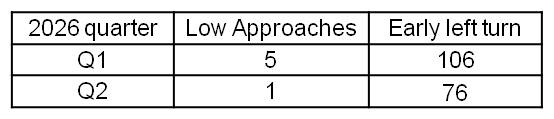
At the 8/13/2026 Commission meeting, city staff presented Noise Abatement Reports that listed "alleged violations" for the first two quarters of 2026:
As long as the FAA sits on the sidelines and refuses to exert their Congressionally-mandated exclusive authority over these "prohibited operations," the Pilot in Command using the Torrance Airport is no longer the final authority as to the operation of their aircraft. Instead, that authority belongs to either:
Only the FAA can tell us WHO IS IN CHARGE?
Jim Gates, Editor
FOOTNOTES:
1. Prior to publication, I shared a draft of this article with the following and asked if they had any comments:
2. What has happened to the FAA between 2020 and now? Their position then was
"state and local governments lack the authority to regulate airspace use, management and efficiency; air traffic control; and aircraft noise at its
source."
Now it appears that the FAA is permitting local governments to make and enforce their own unique set of flight rules that eliminate the authority
of the Pilot in Command.
3. The Zamperini Airfield Preservation Society has filed a lawsuit in Federal court over the City's improper imposition of a ban on touch-and-goes. Issues raised in that lawsuit have a direct bearing on the other "prohibited operations." In October 2025, a week before the bench trial was to begin, the judge paused the hearing in order to review the 15,000 pages of administrative record. The hearing has yet to be rescheduled.
4. I learned that the AOPA Pilot Protection Service, benefit C2A, covers state and local action against the subscriber.